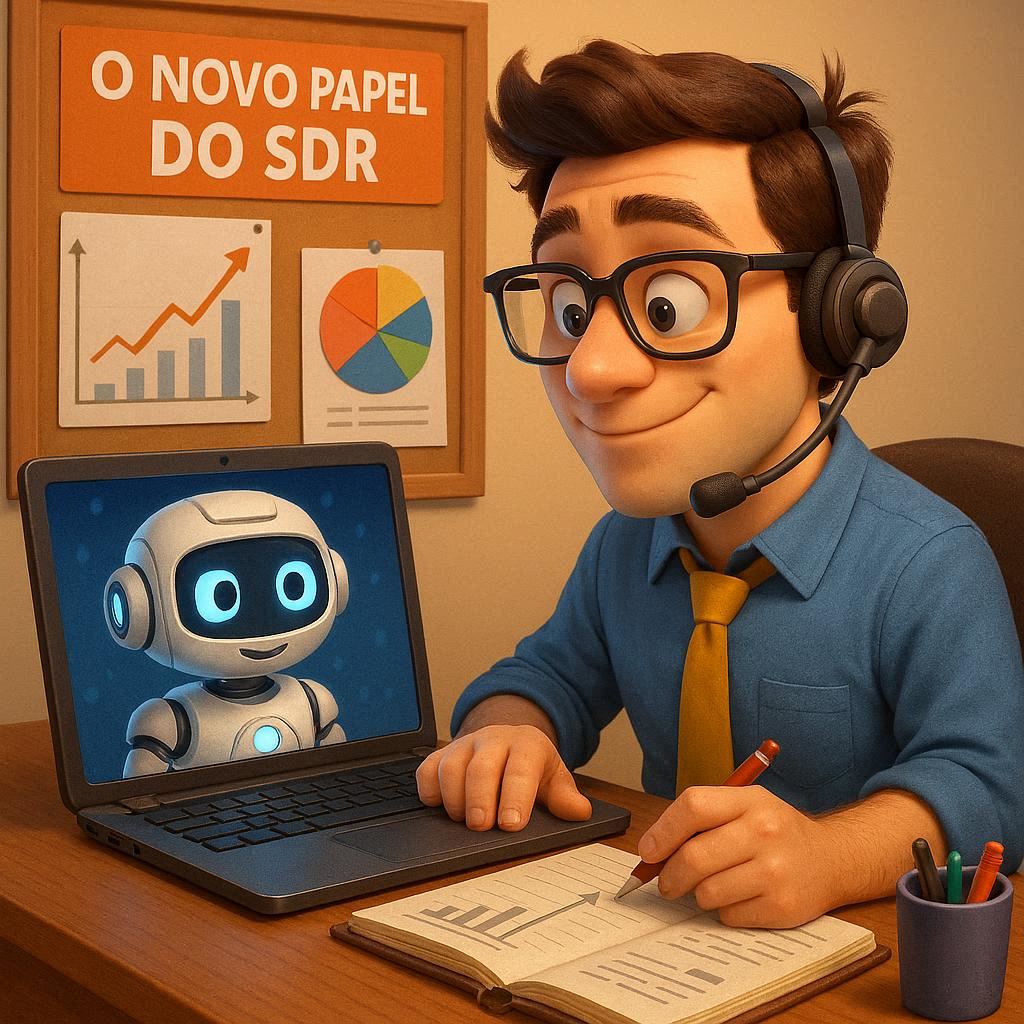
The New Role of SDR in the Age of AI Agents: From Manual Operator to Business Strategist
Discover how AI Agents are redefining the role of SDR, increasing productivity, reducing repetitive tasks, and raising the strategic level of pre-sales teams.
Introduction: The old SDR model no longer scales
For years, the role of the SDR (Sales Development Representative) was structured as an operational function:
- Search for leads
- Assemble lists
- Enrich contacts
- Send messages
- Do follow-ups
- Update CRM
- Schedule meetings
This model worked while the volume was lower and the competition less intense.
But the scenario changed.
Today, the market requires:
- velocity
- Personalization
- Multichannel
- Structured data
- Integration
- Escala
And it's impossible to fulfill all this with manual human effort alone.
This is the context in which AI agents applied to pre-sales operations.
The operational SDR problem
When the SDR spends most of its time performing repetitive tasks, problems arise:
- Low productivity
- Operational tiredness
- High turnover
- Lack of strategic focus
- Inconsistent conversions
- High CAC
Studies show that sellers spend less than 30% of their time actually selling.
The rest is consumed by administrative tasks.
That's not sustainable.
Like the AI agents transform the role of the SDR
AI agents take on activities such as:
- Search and list generation
- Data Enrichment
- Contact validation
- Application of ICP criteria
- Prioritization by intent
- Automatic Follow-ups
- CRM update
- Scheduling
This frees up the SDR for higher-value activities.
The new SDR profile: strategic and consultative
With automated operational tasks, the SDR now focuses on:
- Deep Diagnostics
- Qualified conversations
- Rapport construction
- Understanding real pain
- Identifying opportunities
- Approach strategy
- Multichannel coordination
Paper ceases to be volume and becomes intelligence.
Productivity multiplied
Companies that adopt intelligent automation with AI Agents report:
- Up to 4x more productivity per SDR
- More qualified meetings
- Less time wasted
- Better pipeline quality
- Lower no-show rate
The gain is not only in quantity, but in the quality of the opportunity.
Reduction of turnover and overhead
The traditional SDR model is exhaustive.
When the professional spends the day:
- Copying data
- Sending repetitive messages
- Updating spreadsheets
- Doing manual follow-ups
Motivation falls.
With AI Agents:
- Work becomes more strategic
- The conversation is more interesting
- The focus is relationship
- The professional grows faster
This reduces turnover.
Integration with the model ALLBOUND
The new SDR operates within an ALLBOUND framework:
- Inbound leads
- Outbound leads
- Reengagement
- Multichannel
- Signs of intent
- Full integration
AI agents organize this complexity.
The SDR acts at the point of greatest impact.
The importance of the human in the era of AI
AI agents are not a substitute for SDR.
They replace tasks.
The human remains essential to:
- Empathy
- Negotiation
- Reading nuances
- Building trust
- Business strategy
The winning model is a hybrid.
Like the Nuvia Structure this transformation
Nuvia develops ALLBOUND AI Agents that:
- Take on repetitive tasks
- They structure automatic qualification
- Integrate channels
- They detect intent
- Prioritize leads
- Organize pipelines
This allows the SDR to operate with a strategic focus.
Trends for 2026
What we'll see:
- More strategic SDRs
- Fewer manual tasks
- More data usage
- More automation
- More multichannel integration
- AI as permanent copilot
Companies that maintain a purely manual model will lose competitiveness.
Conclusion
Traditional SDR is evolving.
From manual trader to business strategist.
AI agents don't eliminate the role.
They raise the bar.
If you want to increase productivity without inflating staff, you need to redesign your team's role.
Want to see in practice how Nuvia’s AI Agents can respond to your leads in seconds and increase your conversion rate? Discover Nuvia.
Source
Salesforce — State of Sales HubSpot — Sales Productivity Report McKinsey — AI in Commercial Performance Gartner — Future of Sales Accenture — AI Impact on Workforce